“I didn’t go to the moon, I went much further—for time is the longest distance between two places.” – Tom Wingfield
Long before it became an American classic, The Glass Menagerie was Tennessee Williams rewriting his own history. Premiering in 1944, it introduced the Wingfields—characters drawn so closely from his real mother and sister that the line between memory and invention almost dissolves.
Set in late‑1930s St. Louis, Tom Wingfield recalls the cramped apartment he shared with Amanda—clinging to her faded grandeur—and Laura, who retreats into her glass figurines. When a long‑promised “gentleman caller” finally appears, hope flares briefly before fading, pushing Tom to escape the apartment but not his memories of Laura.
Melbourne Theatre Company’s 2026 production adds a queer-erotic sheen and a contemporary edge. The aesthetic lands confidently in the first act, though it wobbles slightly in the second—especially during Laura’s scene with the Gentleman Caller, which leans on naturalism and sits uneasily against the stylised world built earlier.
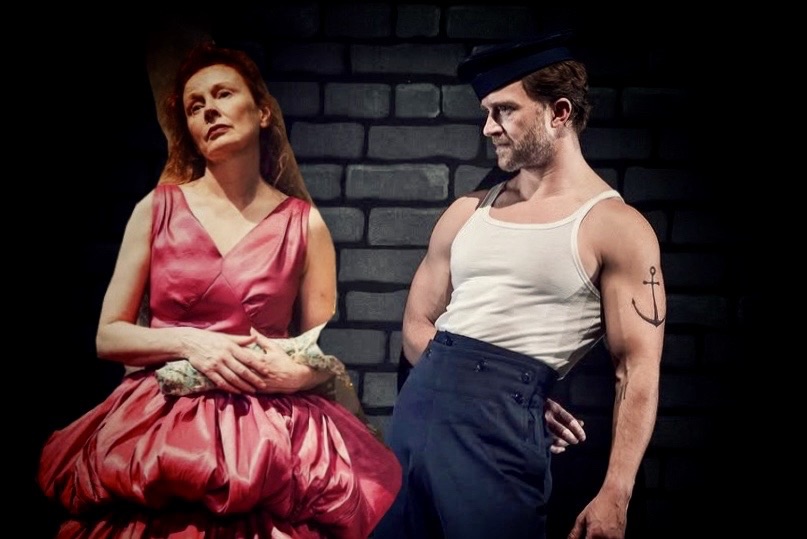
The production embraces the queer subtext of Tom, Williams’s thinly veiled self-portrait, presenting him as closeted and conflicted. Tim Draxl handles the role well, despite being older than the character as written. His presence is commanding, his likability is instant, and his first buff entrance—straight out of Fassbinder’s erotic film Querelle—is a knockout. Draxl carries the show on his broad shoulders with style and grace.
Alison Whyte gives a sharply observed portrayal of Amanda, built on tiny irritations and emotional pressure points. She commands the stage; whether or not we care for her, we’re undeniably invested in her. Special mention goes to Amanda’s choice of outfit to greet the Gentleman Caller in Act Two: it’s ridiculously delicious.
Millie Donaldson, in her professional debut as Laura, delivers a performance shaped by her lived experience as a disabled and neurodivergent artist. Laura is a notoriously elusive role—a character who rarely drives a scene—yet Donaldson makes her compelling in her stillness. You want her to find love, even as you sense she won’t.
Harry McGee completes the ensemble as the Gentleman Caller in a pivotal, candlelit scene. He embodies both the outside world and Laura’s remembered past, carrying the moment with warmth and grounded sincerity. It’s a sympathetic, down-to-earth performance that anchors the play’s emotional centre. In the hush of candlelight, the audience is invited to sit with Harry and Laura and simply observe—a first in the play—and the encounter becomes a quiet turning point for Laura, as she is at last truly seen and heard.
Although written over 80 years ago, The Glass Menagerie still sparkles. This isn’t the definitive production one might hope for, but Mark Wilson’s direction for MTC is thoughtful, occasionally camp, and anchored by four strong performances. Matilda Woodroofe’s costume design is a delight, and Kat Chan’s set serves the interpretation well. It’s a pleasure to hear Williams’s language on stage again—especially in a staging willing to lean toward a modern, queer‑tinged sensibility. If that’s your flavour of Williams, this one delivers.
The Glass Menagerie became Williams’s first major success, winning the New York Drama Critics’ Circle Award in 1945, and this MTC staging reminds us why the play endures. It’s a production I’d readily recommend to anyone who loves good theatre.
More Info: https://linktr.ee/noelanderson
 Harlequin ink
Leave a comment